Chronic patellar tendinopathy, also known as “jumper’s knee”, is a degenerative injury of the patellar tendon that connects the kneecap to the tibia. Unlike acute tendinitis (temporary inflammation), chronic tendinopathy involves structural changes in the tendon tissue: disorganized collagen loss, abnormal neovascularization, and progressive degeneration that does not respond to conventional treatments.
This condition particularly affects athletes in jumping sports (basketball, volleyball, athletics) and physically active individuals, causing persistent pain, functional limitation, and in advanced cases, partial or complete rupture of the patellar tendon.
At the ITRT we address this condition with a regulated approach combining structured rehabilitation and the personalized application of advanced cell therapy medicines with Cultivated Mesenchymal Cells (CMC), authorized by the Spanish Agency for Medicines and Medical Devices (AEMPS). This approach is based on evidence generated in clinical trials specifically for the patellar tendon, with results published in international scientific journals.
What is patellar tendon tendinopathy?
Unlike tendinitis (acute inflammation), chronic tendinopathy involves irreversible structural changes: collagen disorganization, pathological neovascularization, and progressive tendon tissue degeneration.
This process turns a healthy, elastic patellar tendon into fibrotic, rigid tissue with microtears, necrotic areas, and in advanced cases, gap formation visible in imaging studies.
Symptoms and diagnosis
Progressive Clinical Symptoms
- Early stage:
- Pain at the lower pole of the kneecap after intense activity
- Morning stiffness
- Tenderness when palpating the tendon
- Intermediate stage:
- Pain during sports activity
- Difficulty going up/down stairs
- Pain when jumping or changing direction
- Advanced stage:
- Persistent pain, even at rest
- Significant functional limitation
- Loss of strength in knee extension
- Palpable thickening of the patellar tendon
Warning signs of rupture:
- Sudden and intense pain
- Inability to extend the knee
- Palpable gap along the tendon path
Chronicity criterion: symptoms persisting after more than 12 weeks of appropriate conservative treatment.
Causes of chronicity
The chronicity of patellar tendon injuries persists when loading cycles exceed the tissue’s repair capacity, establishing a vicious cycle of degeneration-pain-dysfunction.
When it does not respond to conservative treatment after 12 weeks, advanced therapies may be necessary, such as cell therapy medications with Cultured Mesenchymal Cells (CMC) evaluated in clinical trials authorized by the AEMPS.
Conventional treatment and its limitations
Initial management of patellar tendon tendinopathy is based on load modification and functional rehabilitation. This is effective in reactive cases, but has limitations when structural degeneration is established and symptoms persist beyond 12 weeks of conservative therapy.
Conservative options
Physical therapy
- Limitations:
- Requires long-term strict adherence
- Limited efficacy in advanced degeneration (gap >3mm)
- Does not induce structural regeneration in chronic cases
Shockwave therapy
- Limitations:
- Moderate scientific evidence
- Mainly symptomatic effect (pain relief)
- Not considered structural regenerative therapy
Platelet-Rich Plasma (PRP)
PRP is a platelet concentrate obtained by centrifuging the patient’s blood. It does not contain regenerative cells.
Characteristics:
- Biological product NOT classified as advanced therapy medication
- Immediate processing (1–2 hours) without cell culture
- Main role: natural anti-inflammatory
Limitations:
- Not a regenerative cellular treatment
- No scientifically validated standard dosage
- Heterogeneous evidence in patellar tendon
- No consistent structural regeneration demonstrated
Causes of chronicity
The chronicity of patellar tendon injuries persists when loading cycles exceed the tissue’s repair capacity, establishing a vicious cycle of degeneration-pain-dysfunction.
When it does not respond to conservative treatment after 12 weeks, advanced therapies may be necessary, such as cell therapy medications with Cultured Mesenchymal Cells (CMC) evaluated in clinical trials authorized by the AEMPS.
Differences between CMC and other cellular products
| Characteristic | CMC ITRT (regulated) | Unregulated Products |
| Classification | Advanced Therapy Medicinal Product | Unclassified procedure |
| Manufacturing | GMP-certified cleanroom (21–28 days) | Immediate intraoperative processing |
| Cell dose | 20–120 million, controlled | Not quantified |
| Authorization | Individual authorization by AEMPS | Not required |
| Quality Control | Pharmaceutical Certificate (CPP) | No certification |
| Evidence | Published clinical trials | Anecdotal testimonials |
| Traceability | Complete process traceability | Limited or absent |
| Regeneration | Proven via imaging (MRI) | Not documented |
See also: Pseudoarthrosis: Symptoms, Early Diagnosis, and Advanced Therapies with Cultured Mesenchymal Cells
ITRT clinical trial on patellar tendon: MSC-TENDO-2015
The clinical trial MSC-TENDO-2015 conducted by ITRT is the first study authorized by the AEMPS to document structural regeneration of the patellar tendon using advanced cell therapy drugs with Cultured Mesenchymal Cells (CMC).
Study design
Methodological features:
- Phase: II, randomized, double-blind, controlled
- Code: MSC-TENDO-2015
- EudraCT: 2016-001262-28
- ClinicalTrials.gov: NCT03454737
- Authorized by: AEMPS and the Ethics Committee for Drug Research (CEIm)
- Site: Centro Médico Teknon, Barcelona
Study population:
Patients with chronic patellar tendinopathy refractory to conservative treatment (>12 weeks), with an intratendinous gap ≥3mm confirmed by imaging.
Intervention:
Ultrasound-guided intratendinous injection of autologous CMC (personalized dose of 20–40 million cells), manufactured in a GMP-certified cleanroom for 21–28 days.
Clinical outcomes at 6, 12, and 24 Months
Results from the MSC-TENDO-2015 trial showed sustained clinical improvement and structural regeneration observable in medical imaging.
Clinical results:
Pain reduction:
- Significant decrease on the Visual Analog Scale (VAS)
- Progressive improvement between 6 and 24 months
Functional improvement:
- Increased VISA-P score (specific questionnaire for patellar tendon)
- Improved ability for sports and daily activities
Structural regeneration:
Ultrasound:
- Progressive reduction of the intratendinous gap
- Reorganization of fibrillar pattern
- Decrease in pathological neovascularization
MRI:
- Visible regeneration of the patellar tendon in T2/STIR sequences
- Reduction of intratendinous edema
- Improved structural architecture of the tissue
Safety:
- Safety profile confirmed at 24 months
- No serious adverse events related to the drug
- Well tolerated in all treated patients
Why choose ITRT for patellar tendon treatment
At the ITRT, we are pioneers in the development of advanced therapy medicinal products for tendon injuries, being the
first center to demonstrate recovery of the patellar tendon in a clinical trial authorized by the AEMPS.
With more than 314 doses administered for tendon pathologies and 23 clinical trials completed since 2002, ITRT has one of the most extensive clinical experiences in regulated regenerative medicine in Europe.
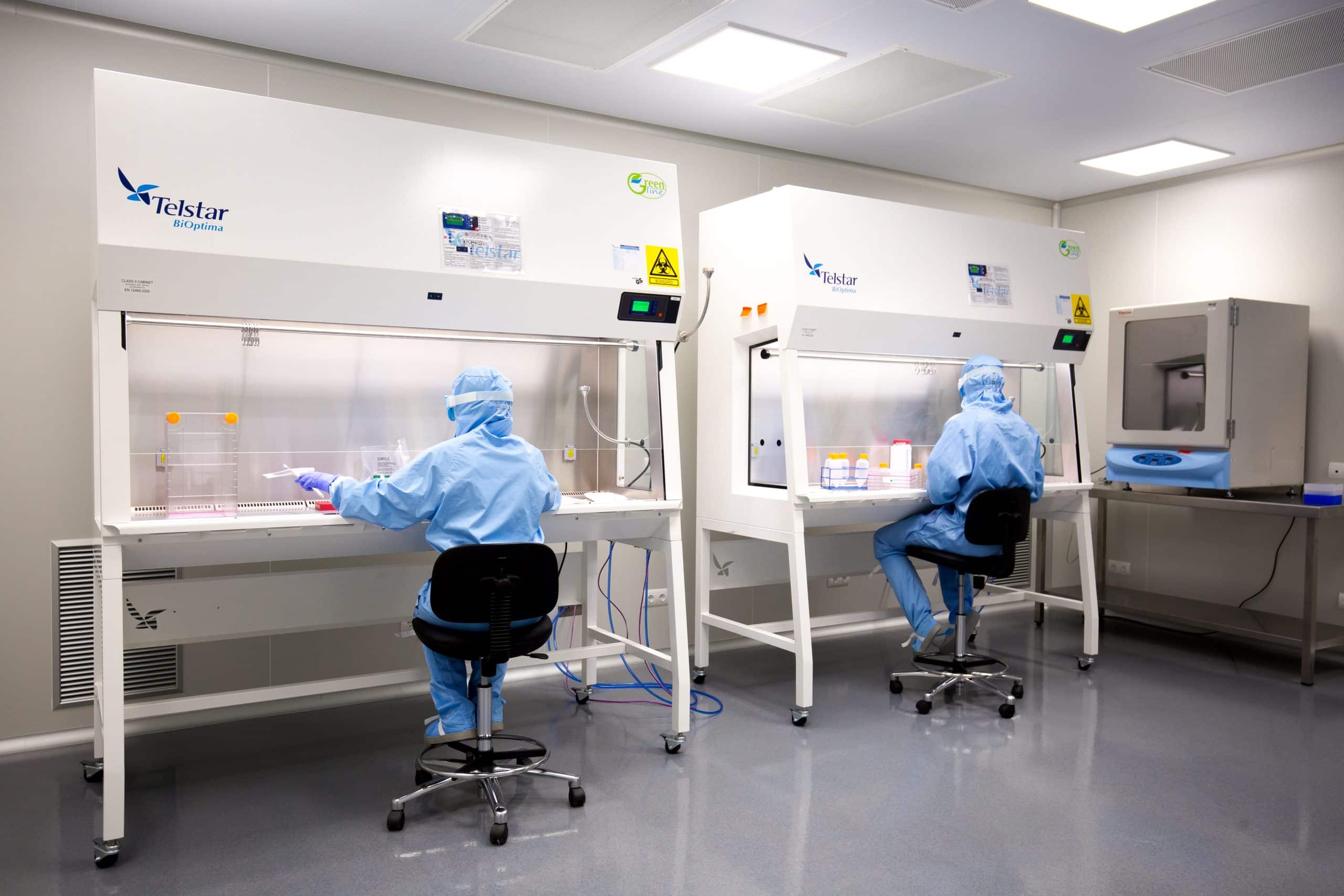
All medicines are manufactured in GMP-certified cleanrooms, with individual AEMPS authorization for each patient, ensuring maximum traceability, safety, and process control.
Clinical results have been published in indexed scientific journals, supporting the transparency and robustness of our therapeutic approach.
If you suffer from persistent tendon pain or have exhausted other treatment options, you may consult ITRT to assess whether you meet the clinical criteria within a regulated medical framework.
Advanced cell therapy medicines with Cultured Mesenchymal Cells (CMC) are subject to medical prescription and require individual authorization from the Spanish Agency of Medicines and Medical Devices (AEMPS). The information presented here is for educational purposes and does not replace medical consultation or professional healthcare advice.