
The Achilles tendon is the most resistant tendinous structure in the human body and, at the same time, one of those that accumulates the most injuries. Pain usually occurs due to a combination of mechanical overload, degenerative changes in the tendon matrix, and individual biomechanical factors. Its correct approach requires imaging diagnosis and a therapeutic strategy adapted to the phase and type of injury.
We will understand the most frequent causes of Achilles tendon pain, the main types of injury (including Achilles tendon rupture), the available treatment options, and the approach developed by the Institute of Tissue Regenerative Therapy (ITRT) at Teknon Medical Center, based on advanced therapy medicinal products with cultured mesenchymal cells (CMC).
What is the Achilles tendon?
The Achilles tendon, or calcaneal tendon, connects the gastrocnemius and soleus muscles with the calcaneal bone. It supports loads that can exceed several times body weight during running, jumping, or propulsion while walking. Its structure, formed mainly by highly organized type I collagen, provides it with elasticity and resistance, but also explains its limited capacity for spontaneous regeneration when damaged.
Why does the Achilles tendon hurt?
Achilles tendon pain rarely has a single cause. In most cases, several converging factors are identified:
Overuse and repetitive loading
It is the most frequent cause, especially in runners, paddle, tennis, or soccer players, and in people who return to physical activity without adequate progression.
Degenerative changes
With age, collagen fibers lose organization and the extracellular matrix deteriorates. This is known as tendinosis: a chronic injury with a degenerative component rather than inflammatory.
Biomechanical factors
Overpronated gait, limb length discrepancy, triceps surae retraction, or inadequate footwear generate areas of overload.
Systemic factors
Diabetes, dyslipidemia, hyperuricemia, rheumatological diseases, and prolonged use of fluoroquinolones or corticosteroids increase the risk of tendon injury.
Acute trauma
An explosive sports gesture on an already weakened tendon can precipitate a partial or complete Achilles tendon rupture.
Types of Achilles tendon injuries
Correctly identifying the type of injury is decisive in defining treatment:
- Insertional tendinopathy: affects the insertion zone at the calcaneus. It is often associated with enthesopathy and Haglund deformity. It is more common in older or overweight patients.
- Non-insertional tendinopathy (midsubstance): located between 2 and 6 cm proximal to the calcaneus, in an area of limited vascularization. It is the most common presentation in athletes and the one that responds best to structural regeneration treatments.
- Partial Achilles tendon rupture: discontinuity of a group of fibers without affecting the entire thickness. Frequently underdiagnosed and confused with chronic tendinopathy.
- Complete Achilles tendon rupture: disruption of continuity of all fibers. It manifests with acute functional impotence, positive Thompson sign, and palpation of a defect in the tendon course. Historically, it has been a first-line surgical indication, although today there are scientifically validated alternatives in selected clinical profiles.
- Paratendinitis and retrocalcaneal bursitis: inflammation of structures peripheral to the tendon. They may coexist with tendinopathies or present in isolation.
See also: Frequent Achilles tendon injuries and biological treatment with cultured mesenchymal cells (CMC)
Imaging diagnosis: essential
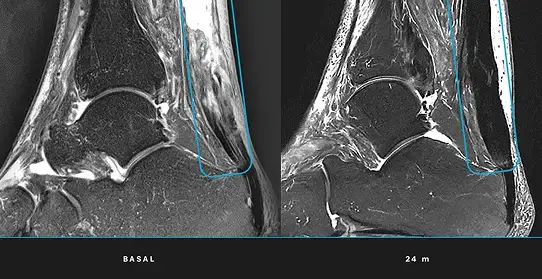
Clinical diagnosis should be complemented with imaging tests. Dynamic ultrasound is very useful in consultation and allows assessment of thickness, vascularization (Doppler), and presence of ruptures. Magnetic resonance imaging (preferably 3T) provides more precise structural characterization: extent of injury, intratendinous edema, fiber quality, and presence of gaps that guide prognosis and therapeutic strategy.
At ITRT, the assessment of any case requires an updated magnetic resonance imaging of the affected tendon as a mandatory requirement.
Treatment options for the Achilles tendon
The approach should be escalated according to the phase and severity of the injury:
1. Conservative treatment
Relative rest, load adjustment, physiotherapy with eccentric exercise (Alfredson protocol, for example), manual therapy, shock waves, and biomechanical footwear review. It is the first line in most tendinopathies and an alternative that relieves inflammation and reduces pain, but does not eliminate it, nor does it remove the injury.
2. Conventional injections
Platelet-rich plasma (PRP), hyaluronic acid, or other injections. They operate in a different regulatory framework from advanced therapy medicinal products and present variable results depending on the preparation, technique, and patient profile, but there is no clinical evidence of structural regeneration in any case.
3. Surgery
Reserved for complete ruptures in patients with specific criteria, failure of conservative treatment, or highly advanced insertional tendinopathies. It involves prolonged periods of immobilization and rehabilitation, with reduced inflammation and pain, but with possible long-term impairment in returning to normal activities.
4. Advanced therapy medicinal products CMC
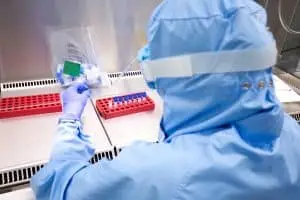
This is the treatment line developed by ITRT. Unlike conventional injections, cultured mesenchymal cells (CMC) are a medication manufactured in a cleanroom under Good Manufacturing Practice (GMP) standards, characterized batch by batch, and administered only with individual authorization from AEMPS for each patient and each batch.
Clinical trials have demonstrated structural regeneration, properly documented by magnetic resonance imaging and complying with all regulatory requirements for this purpose.
See also: What role does AEMPS play in advanced therapy medicinal products?
ITRT’s approach to the Achilles tendon
ITRT, located at Teknon Medical Center, has more than 20 years of clinical and scientific experience in the development of advanced therapy medicinal products with cultured mesenchymal cells (CMC).
Its research program in tendinous pathology is one of the most mature in the field, with results published in international peer-reviewed scientific journals.
Published scientific evidence
The ITRT tendinopathy program has generated, among others, the following publications:
- Rodas G, Soler-Rich R, Rius Tarruella J, et al. American Journal of Sports Medicine, 2021.
- Soler R, Rodas G, Rius-Tarruella J, et al. Orthopaedic Journal of Sports Medicine, 2023.
- Ortega-Cebrià S, Soler-Rich R, Orozco L, Rodas G. Biomedicines, 2024.
Procedure
The medication is administered percutaneously, ultrasound-guided, and under sedation, on an outpatient basis. Patient recovery is rapid and they can even resume normal activities almost immediately.
Individualized assessment
Not all patients are candidates. Indication requires medical assessment with magnetic resonance imaging analysis and comprehensive clinical history review. Treatment authorization is granted by AEMPS on an individual basis for each case.
Frequently asked questions about the Achilles tendon
Does an Achilles tendon rupture always require surgery?
Not necessarily. Surgical indication depends on the type of rupture, patient age and activity level, time elapsed since injury, and imaging test analysis. Today, there are scientifically validated non-surgical alternatives for selected clinical profiles.
How long does pain last in Achilles tendinopathy?
With appropriate conservative treatment, many acute tendinopathies resolve within 6 to 12 weeks. Chronic tendinopathies with structural changes may require specific approaches and longer timeframes.
What are cultured mesenchymal cells (CMC) and how are they applied to the Achilles tendon?
They are cells typically obtained from bone marrow, isolated and cultured in the laboratory under GMP standards for 3 to 4 weeks until a therapeutic dose of millions of cells is reached. They constitute an advanced therapy medicinal product with individual authorization from AEMPS for each patient and batch.
How is CMC treatment different from other injections?
Procedures that apply cells on the same day of extraction do not undergo isolation or culture, are not manufactured under GMP standards, and do not require individual AEMPS authorization. CMC does meet all these regulatory requirements. From a scientific and regulatory perspective, they are substantially different procedures.
How can I request an assessment at ITRT?
You can request an assessment by writing to [email protected] and include, if available, relevant clinical history, previous treatments, and magnetic resonance imaging of the affected tendon. The patient care team will advise you on the steps to follow.
Legal notice:
Advanced therapy medicinal products with cultured mesenchymal cells (CMC) require medical prescription and individual authorization by AEMPS. This content is informational and does not replace medical advice. Clinical results depend on multiple factors and are not extrapolable between patients.