

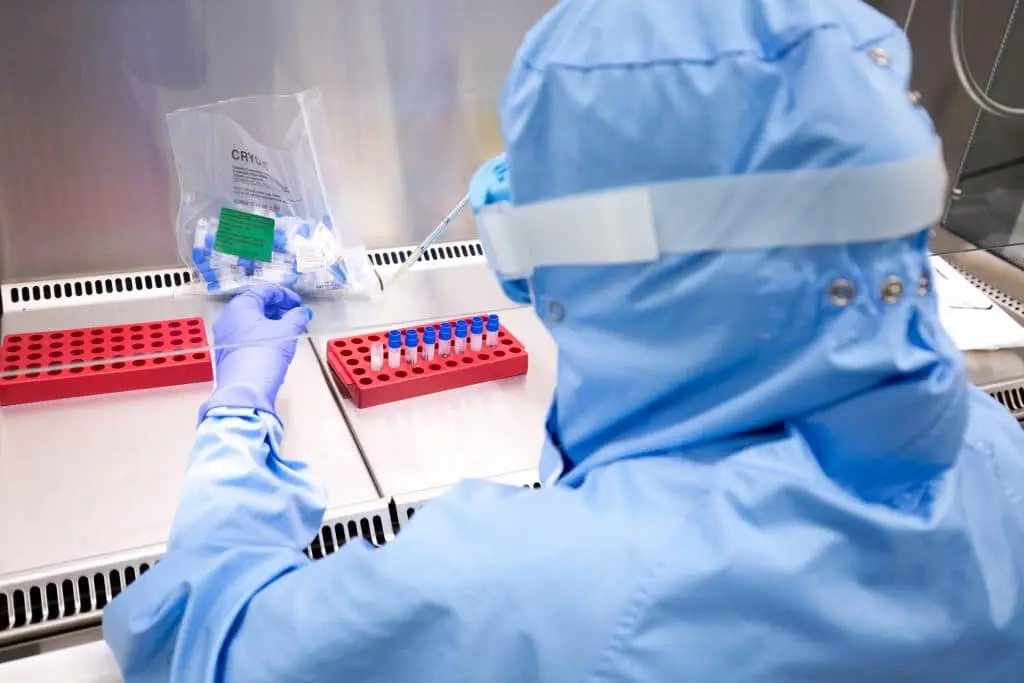
Cultured mesenchymal cells (CMC) are mesenchymal cells obtained from the patient or from a donor, usually from bone marrow, which are isolated and expanded in the laboratory until a defined dose is reached. Because expansion in culture is a substantial manipulation, EU law regulates them as an advanced therapy medicinal product: they are manufactured in a cleanroom under GMP, and in Spain their use requires authorisation from the Spanish Agency of Medicines and Medical Devices (AEMPS).
Author: Dr Robert Soler, Medical Director of ITRT. Updated 12 October 2026.
This content is for information only. Its purpose is not to offer a treatment but to explain what CMC are, why they are regulated as a medicinal product and what the published scientific evidence shows.
What exactly are mesenchymal cells?
Mesenchymal cells, referred to in the scientific literature as mesenchymal stromal cells (MSC), are found in tissues such as bone marrow and adipose tissue. In 2006 the International Society for Cellular Therapy (ISCT) set minimal criteria to identify them: they adhere to plastic in culture, express certain surface markers (CD73, CD90 and CD105) while lacking others, and can differentiate into bone, cartilage and fat in the laboratory (Dominici et al., Cytotherapy, 2006, PMID 16923606).
They are present in the body in very small numbers. To obtain a sufficient and homogeneous quantity they have to be expanded in culture, and this expansion is what distinguishes cultured mesenchymal cells from cells that are harvested and used without culture.
How do CMC differ from so-called “stem cells”?
“Stem cells” is a broad term applied to very different preparations, from research with embryonic cells to procedures in which tissue is harvested and re-injected in the same session without culture. CMC are a specific cell population that has been expanded, characterised and administered at a defined dose. The difference lies not in the name or in how the cells are administered, but in how they are manufactured and the controls they must pass.
Why are CMC considered an advanced therapy medicinal product?
Regulation (EC) No 1394/2007 on advanced therapy medicinal products establishes that cells are regulated as a medicinal product when they have been substantially manipulated, and expanding cells in culture is a substantial manipulation. This is why CMC are manufactured in a cleanroom under Good Manufacturing Practice (GMP), with quality control and batch traceability, and why their use in Spain requires authorisation from the AEMPS.
Being a medicinal product carries a second requirement: it must demonstrate what it does. The fact that a preparation contains cells does not prove that it regenerates tissue. That requires an authorised clinical trial and an objective assessment of the results, for example with imaging.
What is the cell dose and why does it matter?
In a cell-based medicinal product, the dose is the number of viable cells administered, and it is part of the product’s characterisation together with its identity and purity. In ITRT’s clinical trial in chronic patellar tendinopathy, for example, each patient in the treated group received a dose of 20 million autologous CMC (Rodas et al., Am J Sports Med, 2021, PMID 33783227). Without culture, a defined and reproducible dose cannot be guaranteed.
See also: Cultured mesenchymal cells: the dose that defines it all.
How do CMC act in injured tissue?
Research describes several complementary mechanisms. The main one is the release of factors that stimulate the tissue’s own cells and modulate the inflammatory response, known as the paracrine effect; to a lesser extent, the cells can differentiate into cells of the target tissue (Caplan and Correa, Cell Stem Cell, 2011, PMID 21726829). The weight of each mechanism depends on the tissue and the injury, and remains a subject of research.
What does ITRT’s clinical evidence with CMC show?
The most detailed published example is a phase 1/2, randomised, double-blind clinical trial in chronic patellar tendinopathy with a defect larger than 3 mm (EudraCT 2016-001262-28; NCT03454737). Twenty patients received either autologous CMC or an active control treatment, both combined with the same rehabilitation programme.
At six months, pain and function improved in both groups, with no significant differences between them on those scales. The CMC group, however, showed a significantly greater improvement in tendon structure on ultrasound and magnetic resonance imaging, and neither group had relevant adverse events (Rodas et al., Am J Sports Med, 2021, PMID 33783227).
At the 12-month follow-up of the 20 patients, all of whom had by then received CMC, the clinical improvement and the improvement in tendon structure on MRI were maintained, with no adverse events (Soler et al., Orthop J Sports Med, 2023, PMID 37711505). These are results from a small trial in a specific indication, so they cannot be extrapolated to other injuries or to every patient.
See also: ITRT scientific publications.
Can any clinic administer CMC?
No. As an advanced therapy medicinal product, CMC must be manufactured in GMP-authorised facilities, and their use requires authorisation from the competent authority, a medical prescription and regulated clinical follow-up. To judge whether a cell-based treatment meets this framework, it is worth asking who manufactures it, under which authorisation it is administered and which clinical trial supports it.
See also: Which cell-based treatments can be considered legal and regenerative?
Sources
- Dominici M, et al. Minimal criteria for defining multipotent mesenchymal stromal cells. The International Society for Cellular Therapy position statement. Cytotherapy, 2006 (PMID 16923606).
- Caplan AI, Correa D. The MSC: an injury drugstore. Cell Stem Cell, 2011 (PMID 21726829).
- Rodas G, Soler-Rich R, et al. Effect of autologous expanded bone marrow mesenchymal stem cells or leukocyte-poor platelet-rich plasma in chronic patellar tendinopathy (with gap >3 mm). Am J Sports Med, 2021 (PMID 33783227).
- Soler R, Rodas G, et al. Safety and efficacy of bone marrow-derived mesenchymal stem cells for chronic patellar tendinopathy (with gap >3 mm) in patients: 12-month follow-up results of a phase 1/2 clinical trial. Orthop J Sports Med, 2023 (PMID 37711505).
- Regulation (EC) No 1394/2007 of the European Parliament and of the Council of 13 November 2007 on advanced therapy medicinal products (EUR-Lex).
Advanced cell therapy medicinal products based on cultured mesenchymal cells (CMC) require a medical prescription and individual authorisation from the AEMPS. This content is for educational purposes and does not replace medical advice. Clinical results depend on multiple factors and cannot be extrapolated between patients.