
Every year, thousands of people are diagnosed with a herniated disc without nerve compression: the disc has shifted, but it does not press on any nerve root. There is no radiating leg pain or loss of strength, just mechanical low back pain that, in many cases, does not respond well to physical therapy or anti-inflammatories.
It is a common condition both in athletes exposed to repeated loading of the spine and in patients with disc degeneration related to age or to their work, and it usually raises the same question: is there any treatment capable of structurally regenerating the intervertebral disc, or are the only real options learning to live with the pain or waiting until things get bad enough to consider surgery?
In this article we explain what the scientific evidence on structural regeneration of the intervertebral disc says, including research with Cultured Mesenchymal Cells (CMC), an advanced cell therapy medicine that in Spain can only be administered under individual authorization from the Spanish Agency of Medicines and Medical Devices (AEMPS), and always within an authorized clinical trial.
What is a herniated disc without nerve compression?
Before talking about treatments, it is worth clarifying what a herniated disc is, because not all of them are the same and the prognosis changes from case to case.
The intervertebral disc is made up of a tough outer ring (annulus fibrosus) surrounding a gel-like center (nucleus pulposus), and its job is to cushion the load between two vertebrae. With wear, that ring can develop fissures.
Depending on how much material shifts and in which direction, several grades are distinguished:
- Disc protrusion, in which the nucleus bulges outward but the annulus fibrosus remains intact.
- Contained disc herniation, in which the annulus has torn but the material stays within the posterior longitudinal ligament.
- Extruded herniation, in which the material breaks through that ligament.
A herniated disc without nerve compression, that is, without nerve root involvement, is one in which the disc material has shifted without compressing a nerve root. This has clear clinical consequences, there is no pain radiating along a specific dermatome, no tingling and no loss of strength in the leg, symptoms that do tend to accompany nerve root compression.
The most common presentation is mechanical low back pain, sometimes with stiffness, confirmed by MRI, the reference imaging test for assessing the degree of disc degeneration, the type of herniation and, above all, for ruling out associated nerve involvement.
See also: Persistent low back pain and its management with Cultured Mesenchymal Cells (CMC)
What options exist today and what are their limits
The initial approach to a herniated disc without nerve compression usually relies on physical therapy, supervised therapeutic exercise and, if the pain calls for it, anti-inflammatories or epidural corticosteroid injections.
In a significant share of patients, this conservative treatment brings the pain under control within the first weeks or months, especially when combined with good adherence to exercise.
When the pain becomes chronic or significantly limits daily or athletic activity, one of the most searched questions about this condition comes up, whether or not to operate. Disc surgery may be indicated in selected cases, especially when there is associated nerve compression that does not respond to other measures, but in a herniated disc without nerve compression its role is more debated.
It is an effective procedure for correcting the anatomy and relieving specific symptoms, but it carries the risks inherent to any spinal surgery and does not act on the process that caused the herniation.
Neither physical therapy, nor drug treatment, nor surgery addresses that underlying cause: the progressive loss of cells and functional matrix within the disc itself. These are approaches that relieve the symptom or correct the anatomy, but they do not structurally regenerate disc tissue.
That limitation, common to all three options, is what has driven a line of research over the past twenty years focused on a different question: whether it is possible to act directly on the damaged disc.
What the scientific evidence says: CMC and disc regeneration
When people talk about “stem cells” for the spine, that colloquial label covers very different products, and the difference is not just a matter of terminology, it is scientific and regulatory.
A cell concentrate obtained and reinjected in the same session, for example from bone marrow or fat tissue, is a minimally manipulated product, since it does not go through a laboratory expansion process, it does not allow the actual cell dose administered to be precisely characterized or quantified, it is not manufactured under Good Manufacturing Practice (GMP) standards and, for that reason, it does not require authorization as a medicine.
Cultured Mesenchymal Cells (CMC) are something else: an advanced cell therapy medicine that requires substantial manipulation through ex vivo expansion in a clean room, under GMP standards, with a personalized cell dose, characterized and subject to quality control, with full batch traceability and, in Spain, individual authorization from the AEMPS for each patient.
See also: How to tell whether a mesenchymal cell treatment is legal
Research with CMC in disc pathology arose precisely to answer the question of whether structural regeneration is possible. The reference trial in this field, linked to the same research team as ITRT, is Orozco et al., Transplantation, 2011 (PMID 21792091): a pilot study in 10 patients with chronic low back pain from degenerative disc disease with an intact annulus fibrosus, confirmed by discography, that is, without a herniated disc, and with no response to at least 6 months of conservative treatment.
Between 80 and 90 milliliters of bone marrow were taken from each patient’s iliac crest; the mesenchymal cells were expanded in the laboratory and injected directly into the nucleus of the affected disc, in an outpatient procedure with no hospital stay.
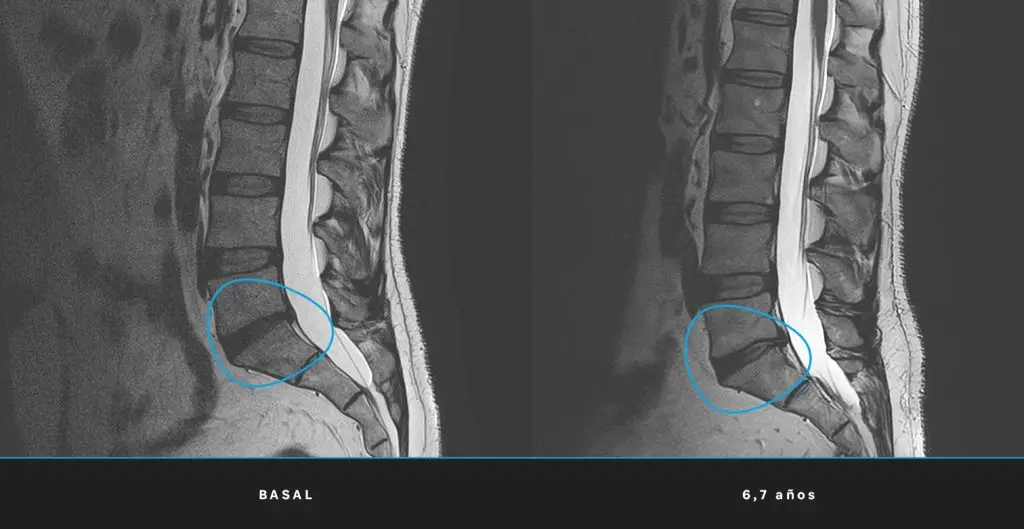
At 12 months of follow-up, pain measured on the VAS scale dropped from an average of 68.9 to 20.0 points out of 100, and functional disability, measured with the Oswestry Disability Index, went from 25.0 to 7.4 points out of 100; 85% of that improvement had already occurred within the first 3 months. On follow-up MRI, disc height showed no significant changes, but a trend toward increased disc water content was observed, from 0.62 to 0.72, with a statistical value at the threshold of significance, consistent with improved disc hydration. No serious adverse events were recorded and 9 of the 10 patients improved.
It is worth being precise about what this study does and does not show:
- Its population had degenerative disc disease without herniation, with an intact annulus fibrosus, not a herniated disc.
- It is the strongest and most direct evidence available on the ability of CMC to act on disc tissue itself, but the indication studied is disc degeneration at a stage before herniation, not an established herniation.
- In a herniated disc without nerve compression, the disc usually shows a degree of degeneration similar to that of these patients, which makes this line of research relevant to the case, although the direct translation from one condition to the other has not yet been demonstrated in trials designed specifically for herniated discs.
See also: Structural regeneration of the lumbar disc with Cultured Mesenchymal Cells (CMC)
Within this research framework, ITRT develops its advanced cell therapy medicines under express authorization from the AEMPS, with manufacturing in a certified clean room, a characterized cell dose and full traceability, inside clinical trials authorized and monitored by the AEMPS itself and by the Research Ethics Committees for medicinal products (CEIm).
Outside that regulated framework, any cell injection, whatever name it is offered under, does not carry the same guarantees of quality, safety or structured clinical follow-up.
See also: Registry of clinical trials with Cultured Mesenchymal Cells (CMC)
An individualized decision, not a promise
The answer to the question we opened this article with, about regeneration of the intervertebral disc, is that research is advancing, but more solidly in degenerative disc disease without herniation than in an established herniated disc, and with results that combine structural signals with clinical questions that are still open.
Not all herniated discs without nerve compression require the same approach. Physical therapy, conservative treatment, possible surgery and research with advanced cell therapy medicines such as CMC address different moments and different goals within the course of disc disease.
Which option, or which combination of them, applies to each case is an individualized clinical decision that depends on the degree of degeneration, the response to previous treatments and each patient’s goals, and one that should be assessed together with the treating medical team.
Frequently asked questions
Is a herniated disc without nerve compression the same as a herniated disc with sciatica?
No. Sciatica appears when the herniation compresses a nerve root and produces pain radiating down the leg along a specific dermatome, together with possible tingling or loss of strength. In a herniated disc without nerve compression, the disc material has shifted but does not press on any root, so the pain is usually confined to the lower back.
Is treatment with Cultured Mesenchymal Cells (CMC) the same as a same-day “stem cell” injection?
No, and the difference matters. A same-day “stem cell” injection is usually a minimally manipulated cell concentrate, with no laboratory expansion and no characterization of the dose, and it is not subject to authorization as a medicine. CMC are an advanced cell therapy medicine, manufactured in a clean room under GMP standards, with a characterized cell dose and individual authorization from the AEMPS.
What sets an advanced cell therapy medicine apart from an unregulated procedure?
Authorization. An advanced cell therapy medicine such as CMC can only be administered inside a clinical trial authorized by the AEMPS and overseen by a Research Ethics Committee for medicinal products (CEIm), with clean room manufacturing, quality control and full traceability. An unregulated procedure lacks that oversight, regardless of how it is advertised.
Have CMC been shown to regenerate the disc in patients with a herniated disc?
The strongest evidence to date comes from patients with degenerative disc disease without herniation, not from patients with an established herniated disc. The trials show functional improvements and measurable changes on MRI, with results that combine clear structural signals and clinical questions that are still open, as explained in the previous section. Research specific to herniated discs is still ongoing.
What role does MRI play in this follow-up?
It is the central test, both for the initial diagnosis, since it distinguishes protrusion, contained herniation and extruded herniation and confirms the absence of nerve compression, and for later follow-up, because it is the technique used in clinical trials to assess changes in disc height, hydration and structure.
How is the use of an advanced cell therapy medicine authorized for a specific patient?
It requires an individualized medical assessment and a specific authorization from the AEMPS for that patient and that clinical trial, within the framework of European regulations on advanced therapy medicines. It is not a procedure offered generally, but a case-by-case authorization.
Mandatory legal notice
Advanced cell therapy medicine (CMC), subject to medical prescription and individual authorization by the AEMPS. Informational content, not a substitute for medical advice.